
“When should we start with bilingualism?”
This is one of the most common questions I hear when it comes to raising multilingual children. And if you’re asking yourself that too, you’re definitely not alone. For many parents, the idea of raising a child speaking more than one language sounds wonderful in theory, but in practice, it’s a sea of questions, not least about when to begin.
How do we do it? Will it confuse them? Is it too early? Or too late?
Let me be clear: start now!
If you’re thinking about it, wondering whether bilingualism might be good for your child, whether now is the right moment, or if you should wait until they speak more, understand more, or start school—my heartfelt plea is: don’t wait. There is no better time than the present. The sooner you start, the more natural, effective, and successful the process will be.
Why starting early matters
Children’s brains are uniquely wired to absorb language in the early years. Babies are born able to perceive all the sounds of all the world’s languages. Over time, their brain starts to tune in to the sounds that matter most in their environment. That means: the earlier your child hears both (or more) languages, the more effortlessly they will absorb them.
Research in fields like psycholinguistics and developmental cognitive neuroscience backs this up. Frameworks like the Sensitive Period Hypothesis (originally “Critical Period” by Lenneberg, 1967, see explanation here) suggest there is an effective window for language acquisition in early childhood. While learning is always possible, earlier exposure tends to result in more instinctive language use.
Our personal journey
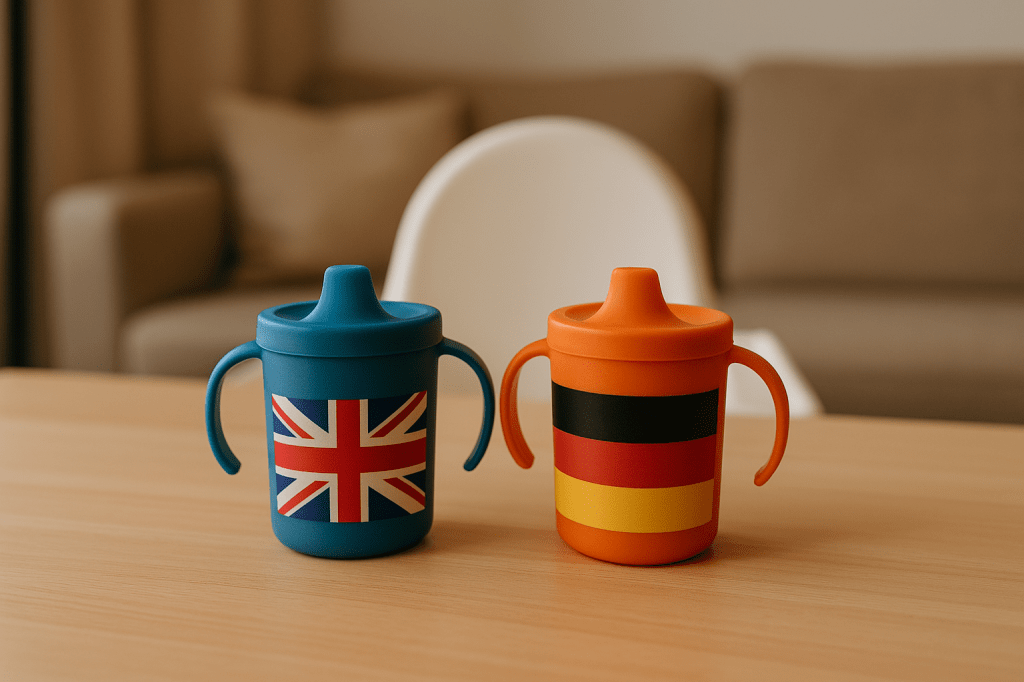
For my partner and me, it was a no-brainer. I’m British, he’s German, and neither of our families speak the other’s language. So if we wanted our daughter to connect with her cousins, grandparents and aunties on both sides, two languages were simply a must. Plus, as an language lecturer I’d be a pretty poor role model if I didn’t teach my child English!
That said, our situation isn’t everyone’s. Some families live abroad with less direct need for two languages, others juggle more than two, and some aren’t sure if they’re “fluent enough” to pass on a language. And then there’s the big question of how to begin.
Feeling unsure about your setup?
I get it. Your constellation of languages, your family’s dynamics, your environment – all of these raise real, individual questions. But I promise: it is possible. And I can help you with that.
What it looked like for us
When our Little Bean was a baby, I was home with her and spoke English all the time. We went to English baby groups, I sang in English, narrated our day, read books. Her papa spoke German, and although German is our family language at home, most of her early input came from me. My husband sometimes worried she wasn’t getting enough German, but also felt it was less important in the baby stage.
At one, she started German-speaking Kita. And pretty quickly, German became her stronger language. Now, at 2.5 years old, she uses German sentence structures, even if the words are still often English. Code mixing like this is developmentally normal, but still hard when grandparents can’t understand her, even though she’s such a little chatterbox! I know this phase will pass, but yes, sometimes it does sting.
Starting a bit later? That works too.
A close friend of mine only started using her home language with her son when he was nearly five. She’d been hesitant, thinking it might be too confusing. But once she began reading bedtime stories and using simple phrases consistently, her son picked it up incredibly quickly. He now understands both parents perfectly and switches easily depending on who he’s speaking with. It’s a great reminder: earlier is better – but later is far from lost!
Common worries – and what’s really true
That’s something I hear often: worries about code-mixing, about one language lagging behind, or about children speaking “late”. But the truth is, bilingualism doesn’t delay language. Children learn to speak at their own individual pace, no matter how many languages they’re learning. And they all get there in the end! Ours was using little 3-word sentences before she was two (granted, I am a language teacher with years of experience in early years language acquisition, so that might help a bit!) – no language devlopment delay caused by her bilingualism!
Not perfect? You don’t have to be.
Start as early as you can, even in pregnancy. You are not confusing your child; You’re giving them tools. Even if you’re not a “perfect” speaker (and whjo really ever is?!), if you can communicate fluently, then you’re bilingual. That’s enough. And you’re absolutely good enough to pass it on!
Worried about grammar? That’s what books, songs and cartoons are for. But anyway, the most powerful tool is real interaction. Kids learn from meaning and connection, not from flawless accuracy.
A moment I’ll never forget
The biggest reward? For me, it was the day Little Bean asked my mum (her “Nanny”) for something in German, didn’t get what she needed, and then tried again with some English words. That moment of flexibility, of trying to make herself understood, showed me just how capable she already is! Kids’ brains are amazing! My monolingual parents might not realise what a milestone that was. But I did. And it made everything feel worth it!
So, when should you start?
If you’re wondering when to start bilingualism at home, my answer is: now. Whether your child is still in your belly, just starting to babble, or already chatting away in one language. It’s never too early, or too late, to begin.
And if you’re not sure how to go about it, just know: you’re not alone. Every family is different. And I’d be honoured to help you find the way that fits your life.
Ready to take the next step in your bilingual parenting journey?
Whether you’re just getting started or feeling stuck somewhere along the way, I offer personalised support for international families like yours. Click here to check out my support guidance options here or send me an email to chat about what’s possible for your family setup.
Want to hear more ideas, advice and anecdotes from me about bilingual parenting? 👉 Add your email to my list so I can stay in touch!

 The Maaster Plan
Leave a comment