
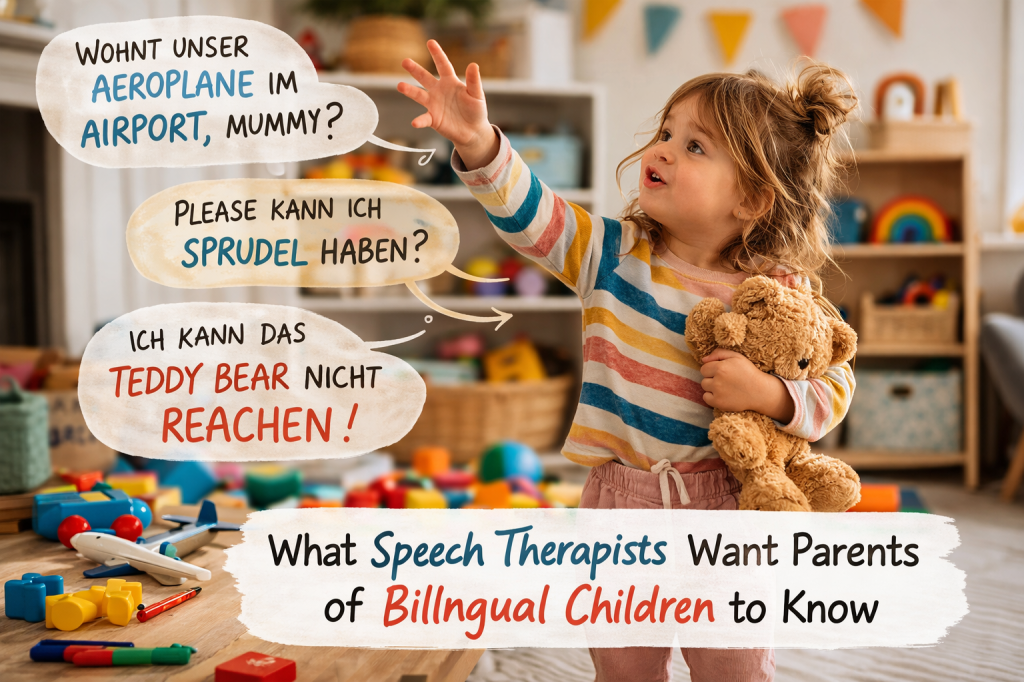
The other morning my daughter looked at me very seriously and asked: “Wohnt unser aeroplane im airport, mummy?”
A few minutes later she wanted a drink. “Please kann ich Sprudel haben?”
Later, while we were running around the living room, she shouted triumphantly: “Du catchst mich, ok?”
At the moment almost every sentence she produces is a cheerful mixture of German grammar and English vocabulary.
If you’re raising a multilingual child, this probably sounds rather familiar. If you’re not used to hearing children grow up with two languages, it can sound slightly alarming.
And that’s usually when the well-meaning comments begin.
When my daughter started nursery, one or two of the teachers occasionally mentioned that they didn’t always understand what she was saying. At one point they even suggested that perhaps I should stop speaking English with her. After all, my German is good. Wouldn’t it be easier if we just stuck to one language?
I’ll be honest. I was fairly annoyed.
Not because the teachers meant any harm. They were trying to be helpful. But the advice was based on one of the most persistent myths about bilingual children: the idea that hearing two languages confuses them.
It doesn’t.
In fact, what my daughter is doing right now is exactly what multilingual children are supposed to do.
Mixing languages is part of normal bilingual development
One of the things that I often explain is that multilingual children produce some very typical mix-ups while they are learning two languages. Speech therapists will tell you, these are not “mistakes” or language disorders. They are simply the result of a child applying rules from one language while speaking the other.
If you’ve ever heard sentences like the ones my daughter currently produces, you’ll know exactly what that looks like.
In many of her sentences the basic structure is German, but some of the key vocabulary is English. Sometimes she even applies German grammar to English verbs. For example, “Ich kann das Teddy bear nicht reachen.”
From a bilingual development perspective, this is completely normal. It’s a very typical stage when children are acquiring two languages at the same time. Linguists call this interference, which simply means that rules from one language temporarily influence the other. When children grow up with more than one language, they naturally experiment with combining the linguistic tools they currently have available.
Speech therapists I have spoken with understand these mixed utterances as a normal developmental phase. In most cases children gradually sort this out themselves as their vocabulary grows and they gain more experience using each language in different contexts.
In other words, if your child produces the occasional linguistic mash-up, you probably don’t need to panic or start booking therapy appointments straight away. Very often you are simply hearing a bilingual brain hard at work!
Why bilingual children shouldn’t be compared with monolingual ones
Another point speech therapists regularly emphasise is that bilingual children should not be compared directly with monolingual milestones.
A monolingual child hears one language all day long. A multilingual child splits their language input between two or more languages. That means vocabulary may appear smaller in each individual language at certain stages, even though the child may actually know the same number of concepts overall. If you only look at one language in isolation, the picture can easily appear more worrying than it actually is.
This is also why speech therapists who work with multilingual families stress the importance of considering all of the child’s languages during an assessment. Looking only at the majority language can underestimate what the child is actually capable of communicating.
Read more here: “Bilingual Children’s Speech Development – Why Monolingual Norms Don’t Apply“
When speech therapy is genuinely needed
In Germany in particular, quite a lot of children are referred to speech therapy (Logopädie), and sometimes multilingual families find themselves under particular scrutiny. Sometimes that referral is entirely appropriate. But sometimes it simply reflects uncertainty about how bilingual language development works.
One point speech pathologists make very clearly is that if a child has a genuine language development disorder, it affects all of their languages. A language disorder does not appear in just one language while the others develop normally.
Typical warning signs might include speech that is very difficult to understand, an extremely limited vocabulary, or very short and simplified utterances compared with children of a similar age.
Multilingual children with a language disorder benefit from speech therapy just as much as monolingual children do. But multilingualism itself is not the cause. Understanding this distinction can help parents avoid unnecessary anxiety when their child’s language development simply reflects the normal complexity of learning more than one language.
What speech therapists actually recommend for multilingual families
Interestingly, the advice speech therapists and the German Federal Association of Speech and Language Therapists (Deutscher Bundesverband für Logopädie e.V.) give multilingual parents is often quite straightforward.
Parents should speak the language they know best with their child. Natural, comfortable interaction is far more valuable than trying to artificially simplify your speech in a language that doesn’t feel natural.
Children learn language through interaction, not through exercises. Playing, talking, asking questions, repeating and expanding what your child says in natural sentences, these are the things that build language skills over time.
It is also generally not helpful to pressure a child to switch languages on command. Multilingual children often choose the language that feels easiest in that moment. With time and experience they gradually learn which language fits which situation.
In other words, multilingual development does not require linguistic perfection from parents. What matters far more is consistent, meaningful interaction.
Confidence matters for multilingual parents, too
The reason I’m writing about this is that many multilingual parents quietly begin to doubt themselves when teachers, relatives or strangers question their language choices.
I have the advantage of knowing the research and working with professionals in the field. So when someone suggested that I stop speaking English with my daughter, I could explain quite calmly why that wasn’t necessary.
But not everyone has that background. And I would love more multilingual parents to feel confident about the choices they’re making for their families.
Because raising children steeped in multiple languages and cultures is something quite special, even if it occasionally results in sentences like “Du catchst mich, ok?”
Practical ways to support bilingual language development
If you’d like some practical ideas for supporting multilingual language development in everyday family life, I’ve put together a quick-guide that translates these professional recommendations into concrete tips you can actually use at home.
You can download the guide on the subscribers’ area, or click here to get it emailed to you.
 The Maaster Plan
Leave a comment