
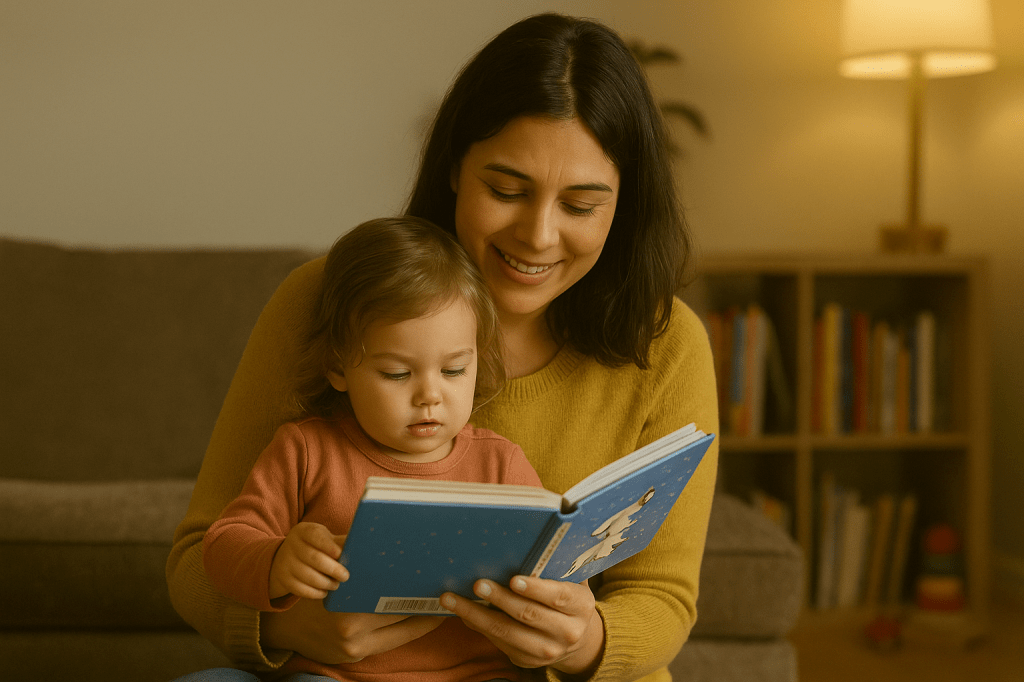
Reading and books are a big part of my life (See here what I’ve read so far this year!), so of course I wanted to share them with my daughter right from the start. And in any case, reading to a child is one of the most spowerful ways to boost their language development. I imagined cosy cuddles, turning pages, her rapt little face… and then reality hit. Toddlers don’t exactly follow the script.
Some days, she’ll sit sweetly and listen. Other days, she’s flipping to the last page while I’m still reading the title. Sometimes, she wants Peppa Pig five times in a row (and yes, I can now recite it in my sleep), and sometimes all she wants is to shout “DOG!” at every animal on the page.
Here’s the thing: it all counts. Even the chaotic, out-of-order, shouty reading counts. And actually, how we read matters just as much as what we read. So here are a few ways to make storytime fun, flexible, and secretly packed with language learning.
1. Make it interactive
Toddlers aren’t passive listeners. They’re wriggle-monsters with opinions. So instead of aiming for silent absorption (ha), turn the book into a back-and-forth.
Try:
- “Can you find the cat?”
- “What’s this called?”
- “Can you roar like the lion?”
- Pause dramatically before a familiar word and let them shout it
Why it helps: The more involved they are, the more they learn. When they point, name, or act something out, they’re building connections between words and meaning. Even if they skip pages like a caffeinated editor, they’re still getting valuable input.
2. Use your voice
You don’t need to be a theatre kid, but trust me: monotone doesn’t cut it. Toddlers rely on your pitch, rhythm, and volume to figure out what’s going on.
So:
- Give characters silly voices
- Add sound effects (“CRASH!”, “moo”)
- Whisper when it’s suspenseful, zoom when the car drives fast
Why it helps: Intonation teaches tone and emotion, even when they don’t know all the words. Plus, you’ll both enjoy it more—and that’s the goal.
3. Talk about the pictures
Most toddler books have, let’s say, minimal plot. Which is perfect, because the pictures are where the language goldmine is.
So go off-script:
- “Oh no, Peppa’s muddy again!”
- “What’s happening here?”
- “Look! A teeny tiny bug on the leaf!”
Why it helps: Talking about pictures gives you a way to introduce more words than are printed on the page. That’s how you sneak in verbs, adjectives, and ideas that aren’t in the text.
4. Rinse and repeat
Yes, it’s the 87th reading of Dear Zoo. No, you’re not alone. But repetition is how kids lock in language.
To make it more useful:
- Emphasise new words: “A biiig elephant!”
- Then expand: “Wow, that big elephant is spraying water!”
Why it helps: Kids need to hear words dozens of times in different ways before they can use them. Repetition feels boring to us, but to them, it’s how things click into place.
5. Use gestures and actions
Reading doesn’t have to be still. In fact, toddlers learn better when their bodies are involved.
So:
- Wave when the character says goodbye
- Hop like the bunny
- Pretend to steer the truck
Why it helps: Gestures reinforce meaning and help kids remember. Their brains link movement and language, so acting things out boosts comprehension.
6. Raising a bilingual kid?
Reading is so important for children learning more than one language. For more ways to boost kids’ bilingual abilities, read this. If you’ve got books in both languages, great. If not, live-translate. I read German books in English all the time. It can be quite mentally challenging, though, which is one reason why parenting between languages can be so exhausting! But my daughter doesn’t care what language we tell her the story in. She can’t read the text yet. And it saves us from having to buy twice the books!
The research? Mixed approaches work:
- One language per book can help with clarity
- Mixing and translating keeps both languages active
- The key? Keep it joyful and consistent
TL:DR – Make it fun!
Doesn’t matter if it’s a classic, a noisy book, or some weird unicorn story from the charity shop. If your child enjoys it, it’s doing good things for their brain. Let them point, shout, interrupt, or “read” to you. It’s all part of the process.
Books + connection + a bit of chaos = language magic.
📚 Want to know more? Like, what we’re actually reading (and re-reading… and hiding under the sofa)? And how to make bilingual storytime work without losing your mind?
Subscribe to my newsletter for honest updates, practical tips, and resources to help you raise curious, confident bilingual kids. No perfection required.

 The Maaster Plan
Leave a reply to Emotional language connection in multilingual parenting: What it is and why your child needs it! – The Maaster Plan Cancel reply