
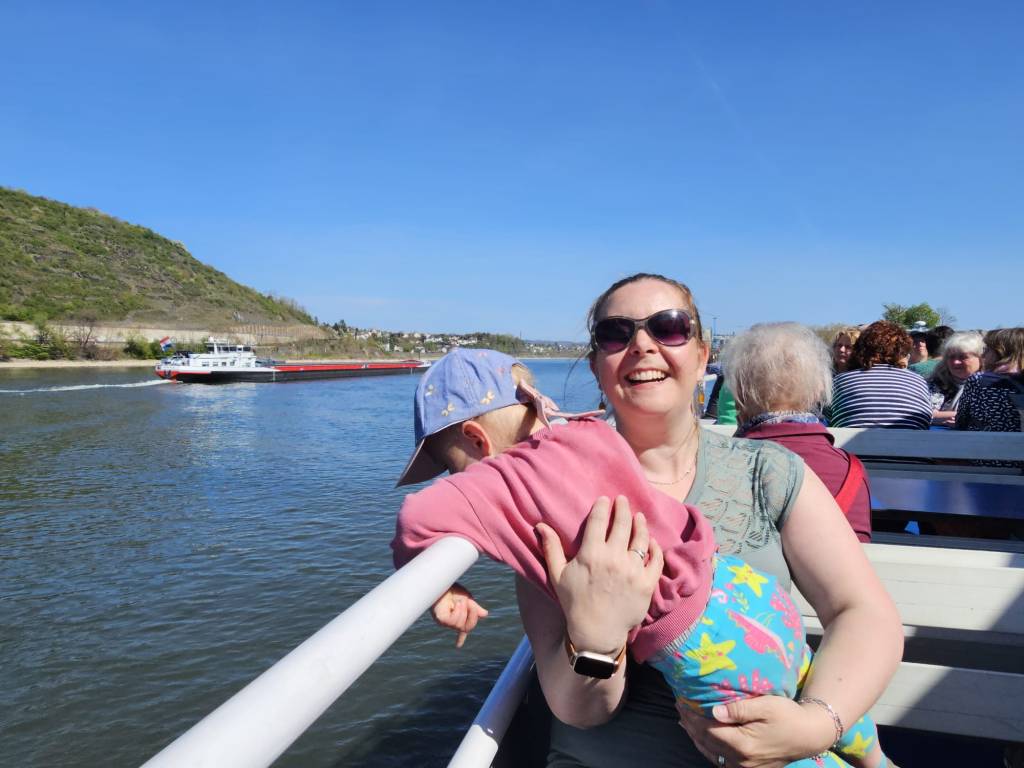
Every day, I get to witness something quietly amazing. I love this tiny human who’s like a little female version of her father, but with my eyes! And on top of that, I get to watch her language skills unfold in real time. It’s endlessly fascinating!
When I think about why I love seeing my daughter learn to speak two languages, it’s not only parenting pride or sweet toddler moments. It’s about the joy of observing early language development “in the wild”!
But it’s also about love in action. Because raising her bilingually isn’t just a cute bonus feature of our life abroad. It’s repetition. It’s consistency. It’s sometimes choosing English when it would be easier to switch. It’s repeating the word again. And again. And again. It’s holding onto something that matters to me, even on the days when nursery dominates and I’m tired.
I’m a language nerd through and through, and watching this little person explore bilingualism, playing with sounds, structures and patterns in two languages, is my happy place! Raising a toddler abroad isn’t always pretty, but it’s full of curiosity, linguistic puzzles and those brilliant “aha!” moments. And yes, it’s also full of moments where I quietly wonder if I’m doing enough. I probably would’ve loved this phase even if we were monolingual. But the bilingual speech development? It’s a bonus layer of fun!
Here are five reasons this process captivates me:
1. It connects her to our family and culture
She can already communicate, in her own delightful toddler way, with both sides of our family. Her nanny and her “Grandank” (as she says), her uncles, aunties and cousins, whether they’re in England or Germany. It means the world to me that we’re making it possible for her to build these relationships from day one. Through language, she won’t just stay connected. She’ll grow to understand the mentality and culture that shaped me. That connection isn’t automatic when you live abroad. It’s something I choose to protect.
2. She’s growing up with multiple worlds
Even at two, she instinctively senses who understands what. She adapts, switches, and invents, sometimes mid-sentence. I see her absorbing the idea that communication isn’t one-size-fits-all. And for a child who’s still mastering verbs? That’s impressive. Even when she doesn’t have the right word, she finds a way, with gestures, synonyms, even invented words. That kind of flexibility is a superpower in any language. At some point, she’ll start choosing words to shape how she sees herself. Right now, she just wants to be understood. But I already see those early sparks of agency.
3. It’s a linguistic playground
We’re not analysing grammar together yet 😉, but I find it endlessly fascinating how her little brain is processing all this information and making sense of it to communicate effectively. Her code-mixing is creative, not chaotic. “Nighty Gute!” and “banana ist fertig” aren’t just cute. They’re language experiments. What researchers might call translanguaging, we just call breakfast. Honestly, it reminds me of all the hours I spent wrestling with German textbooks, and how glad I am she’s absorbing this early instead of fighting her way into it later.
4. It’s a gift for life
She may not realise it yet, but this bilingual start will give her something deeply grounding. Bilingualism has so many benefits but this isn’t about advantages on a CV. It’s about giving her access to all of herself. I had to learn German through school, university, and daily trial and error with a husband who mostly speaks dialect. Giving her this foundation now means she won’t have to fight her way into fluency like I did. That’s something I’m really proud of!
5. Our whole family is learning along
Unexpected bonus: her language journey is brushing up everyone’s skills. My husband’s getting better at English, and my parents are picking up toddler-level German phrases, all thanks to her. She might be the smallest in the family, but she’s turning out to be our most entertaining language teacher!
And maybe that’s the most unexpected part of all. Passing on your language isn’t about perfection. It’s about love. It’s about showing up again tomorrow, even if today was messy. (Especially if today was messy!)
Curious about – or deep in the thick of – raising a little language explorer? Get practical tips, bilingual facts and playful ideas straight to your inbox: 💌Click here!

 The Maaster Plan
Leave a reply to The Difference I Want to Make: As a Multilingual Mum, Language Nerd, and Bilingual Parenting Coach for International Families – The Maaster Plan Cancel reply