
I hate to break it to you, but just speaking your language around your child isn’t always enough.
Yes, children are language sponges. Yes, their brains are wired for soaking up communication from a young age. And yes – if your home situation looks like two parents consistently speaking the same minority language in an environment that supports it, maybe “just talking lots” will work just fine.
But that’s rarely the setup I see.
The multilingual families I know are usually not living in bilingual hotspots or surrounded by speakers of their heritage language. They’re expats or migrants, often in multilingual homes, where the minority language comes from one parent – sometimes only occasionally. Around them? Nurseries, neighbours, social lives – all in the local language. And the kids are incredibly smart, but also incredibly practical. They learn quickly what language gets them what they want fastest. And unless we’re intentional about giving them reasons, opportunities and motivation to use our language – it can quietly fade into passive understanding at best.
This post is here to set the record straight. Because raising bilingual kids “naturally”? It’s not wrong. But it’s not universally successful either.
What Is the ‘Natural Way’ Trend?
The concept of a “natural way” to raise bilingual kids has become very visible on social media recently. But its origins are older and more complex than just a fleeting internet trend.
Parents, influencers, and other endorsers use the term to describe an approach that emphasizes immersion and meaningful communication over structured learning. Ive seena lot of posts with headlines like:
- “Our journey to raising bilingual kids the natural way.”
- “How we naturally foster a second language at home.”
- “We’re choosing a more natural path to bilingualism.”
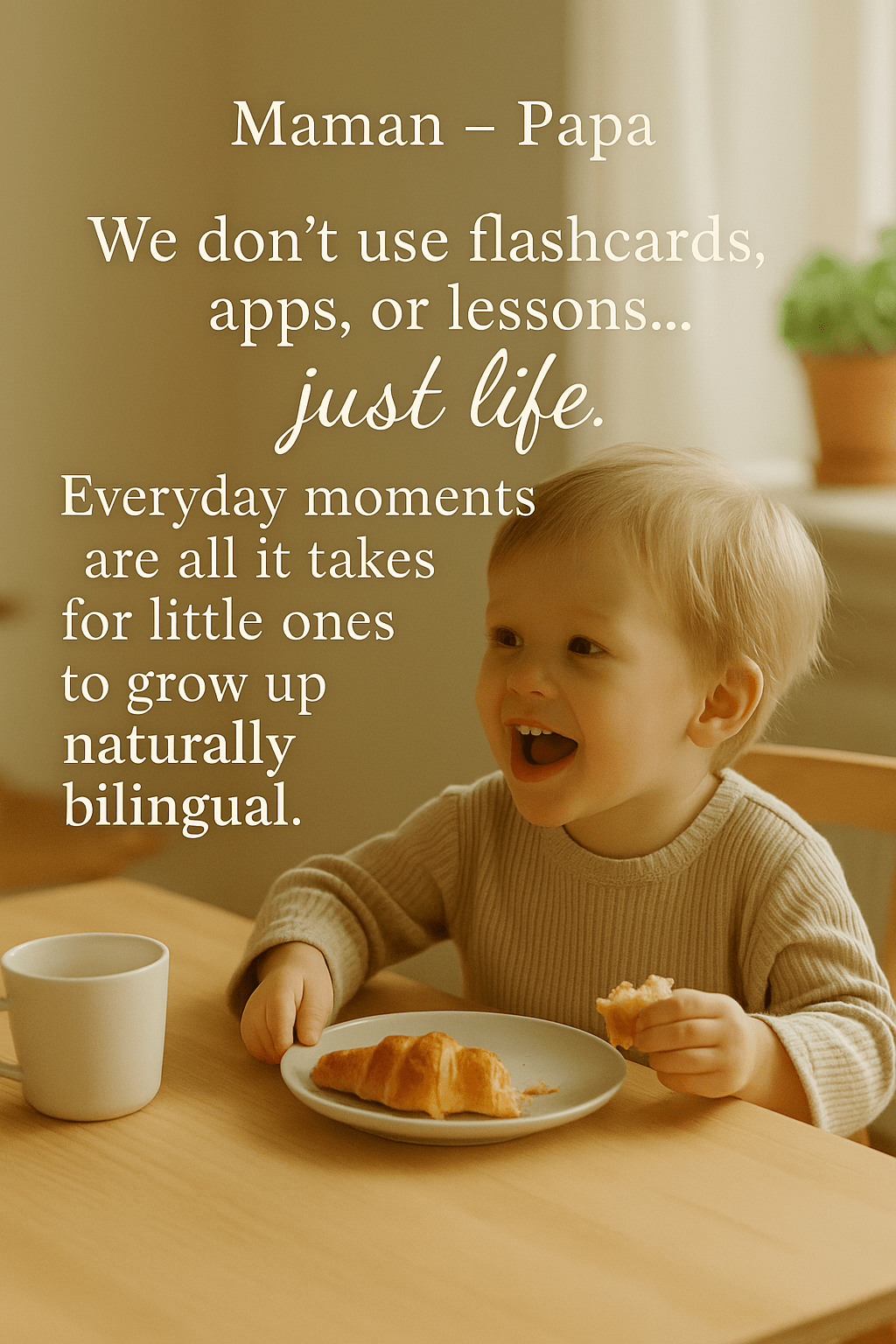
In this context, “natural” is positioned as the opposite of “forced,” “academic,” or “stressful.” It evokes a sense of ease, authenticity, and integration into daily family life. It looks like this:
On platforms like Instagram and TikTok, there’s a steady stream of content promoting an idealized, seemingly effortless version of bilingual parenting. It often looks like:
- Aesthetically pleasing pictures of children seamlessly switching languages in sunny playrooms or charming cafes
- The “just live your life” narrative: Just talk to your kids normally, read books, sing songs, and bilingualism will blossom
- Emphasis on effortlessness: There’s little mention of the behind-the-scenes work, setbacks, or planning that go into maintaining two or more languages
The term “naturally” appeals because it rejects flashcards and drills, offering a holistic, emotionally connected alternative. But this interpretation quietly implies that anything more intentional is too much – or a sign you’re doing it wrong.
And Where Does This Idea Come From?
The idea of raising kids bilingually “naturally” isn’t just an influencer invention, though. It has real roots in both language teaching and parenting methods. For example, the One Parent, One Language (OPOL) strategy, coined by French linguist Maurice Grammont in 1902, was designed to help children absorb two languages without confusion.
Plus, research has long confirmed that children’s brains are wired to learn language through meaningful interaction, not formal grammar lessons. So yes, the science backs up the idea that language can be acquired naturally – at least in theory.
And let’s not forget: part of this movement came as a necessary pushback against outdated fears that bilingualism would confuse kids or delay their speech. Presenting bilingualism as “natural and beneficial” helped a lot of families feel more confident.
But in simplifying the message, we ended up with a new myth: that “natural” equals “easy.”
What Raising Kids “Naturally” Promises
This approach is often portrayed as the calm, wise alternative to structured or intensive methods. It suggests:
- Exposure is enough for active language use
- Kids will learn without pressure if the home is loving and language-rich
- Bilingualism happens organically if you just let it
- Just talk to your kids, read books, sing songs, and bilingualism will follow
- Children won’t be confused if each parent sticks to “their” language (as if that solves everything!)
- It’s all supposed to happen effortlessly, without setbacks, awkward moments, or strategic planning
It sounds lovely, doesn’t it? But while this vision is comforting, it can be misleading. When things don’t unfold as easily as promised, many parents feel confused or inadequate.
The Truth: What Social Media Doesn’t Tell You About Raising Bilingual Kids “Naturally”
Raising kids bilingually “naturally” can work – but only under very specific conditions:
- Both parents speak the minority language consistently
- The child has regular, varied exposure to that language in multiple contexts
- There is strong social motivation and identity tied to the language
- The community or extended family reinforces its use
In real life, many multilingual families don’t have that. Especially when:
- One parent speaks the minority language, the other doesn’t
- The child is surrounded by a dominant local language in daycare, school, and daily life
- Travel or connection to the heritage culture is limited
Children do absorb language naturally – but they are also deeply social and goal-oriented. They use the language that works best in their daily life. If they can get by without using a language actively, they usually will.
So while the brain is naturally capable, the circumstances often aren’t.
My Perspective on Raising Kids “Naturally”
I see parents who are doing everything “right” – they speak, they sing, they read – and still feel confused about their child’s language development. The problem isn’t what they’re doing. It’s that they’ve been told it should just “work.”
Let me give you an example from my own family. I speak English to my daughter. That’s our language when we’re alone. But she hears me speak German when Papa’s around, or when friends visit. Naturally, she speaks to me in German too – and for a while, I just answered her in English, thinking we were fine.
Except we weren’t. We were having full-on two-language conversations, and I realised that she wasn’t actively using English at all. She didn’t need to. I understood her. I was doing all the heavy lifting.
So I had to shift: I started recasting what she said in English, and then responding. It made everything a bit more long-winded (and sometimes a bit awkward in public), but it made all the difference. Because just “talking English at her and hoping” wasn’t cutting it. It’s the conscious effort that keeps things alive.
What the idea of raising kids bilingually “naturally” often overlooks is:
- Not all exposure is equal: passive input is not the same as interactive use
- Understanding a language is easier than speaking it, especially without practice
- Children need reasons to use a language, not just opportunities to hear it
- Language development depends not just on quantity but quality, consistency, and social context
Most importantly, it ignores the emotional load: parents quietly wondering, “Am I doing enough?” “Why is this so hard for us, but not for others?” “Am I failing my child?”
You’re not.
You’re navigating a complex, beautiful, and very real situation that needs more than platitudes.
Next Steps: How to Support Bilingualism Without the ‘Ideal’ Setup
Here are some strategies I can recommend:
- Design for interaction, not just exposure: Make space for your child to speak, not just listen. This could be routines, playtime, or regular calls with relatives.
- Create meaningful reasons to use the language: What does your child need your language for? Food requests, bedtime stories, favourite games? Talking to nanny and granddad? Make the language functional.
- Reframe success: Full fluency isn’t the only marker of success. Passive understanding, emotional connection, or cultural pride matter too. It’s not “all or nothing.”
- Ask for support: You don’t have to figure this out alone. Just because it feels “natural” doesn’t mean it should be lonely.
Conclusion
Bilingualism doesn’t have to be effortless to be meaningful. Raising kids “naturally” works beautifully – for some lucky families, in some contexts. But for many of us, it’s not enough. And that doesn’t mean you’re doing it wrong.
It means your family deserves a more tailored path. One that honours your child, your language, your goals, and your reality.
If you’d like more insight, stories, and real talk about bilingual parenting, I send out monthly thoughts, tips, and resources: always real, usually practical, and very often rather humorous!
Click here to join my list so I can stay in touch with you.
You cfan also check out my 1:1 support options – together we’ll create a plan that works for your family!

 The Maaster Plan
Leave a reply to Expat Families: How Children Can Build a Strong Language Identity Abroad – The Maaster Plan Cancel reply