
Last week we spent a few days at my parents’ place. English everywhere, I thought. My brother and his (freshly married, congratulations!) wife were there too, plus their little boy, my daughter’s cousin, roughly the same age.
English immersion, I thought. Books, songs, cuddles, and full-time grandparent energy. My mum was chatting constantly (very loudly – her hearing aid wasn’t working!), my dad was reading picture books on repeat, and the TV stayed firmly off.
It was the perfect setup for a magical grandparent boost in English.
Except… it didn’t happen.
My daughter listened, played, enjoyed every minute, and then walked off and spoke in German.
You speak your language. You read books. You even fly in grandparents for backup. But your child still answers in the local language, and you wonder: Am I doing this right?
You’re not alone.
This post is a clear, research-backed look at what really influences language development in bilingual kids. Spoiler: it’s not just about how much you talk.
What early research suggested
Some of the early, influential work in bilingual parenting gave parents a real sense of agency. Studies like Elizabeth Lanza’s research on parental discourse strategies introduced ideas like “minimal grasp” (where a parent gently signals non-understanding to support use of the target language). These strategies were shown to encourage expressive language without pressure or drilling.
Honestly, sometimes I don’t even need to feign non-understanding. I genuinely have no idea what she’s trying to say. She’ll come out with this funky German-English blend, and I don’t even know which language to listen in. She gets frustrated, I get lost, and the moment slips by. It’s probably a good sign that this strategy might not work as reliably as once thought, at least not in the early years.
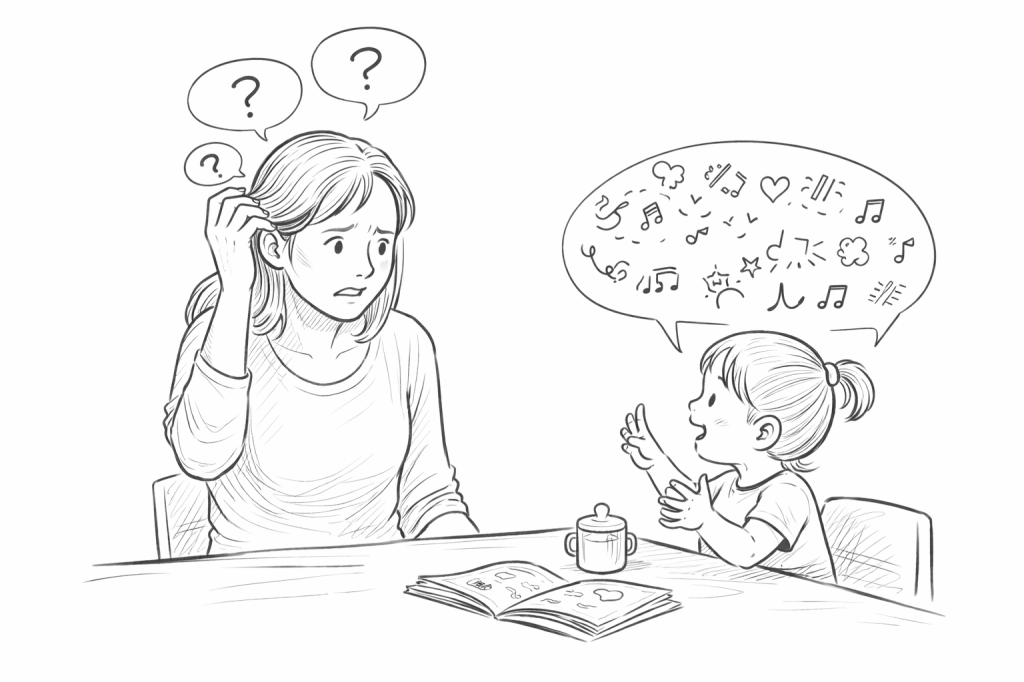
That said, I have seen her try a different word, in a different language, when my mother didn’t understand what she wanted. But she’s not even three yet. That wasn’t a conscious, bilingual problem-solving moment. It was just a toddler testing sounds to get what she needed. Which says a lot: kids have agency, yes. But the kind of cognitive awareness that language strategies often assume? That’s still a long way off at the age when most of the real language learning happens.
In other words: strategies can help, but they’re not magic.
When parents prioritise understanding and connection, children do feel safer to experiment. But that doesn’t always translate into perfect, predictable outcomes. And that’s okay.
What later research complicated
As more studies came in, the picture got messier.
Even when parents used “recommended” strategies consistently.
Even when OPOL (One Parent One Language) was followed to the letter.
Even when parental language behaviour looked textbook perfect.
I’ve written before about how absolute consistency in one approach, like OPOL or ML@H, just isn’t feasible for most international families. We try to follow it, but life is life, and Little Bean hears me speaking German, too. Sometimes it’s not that OPOL isn’t working as a strategy, it’s that OPOL (or whatever other neat category someone wants to box you into) just doesn’t work for the set-up our lives actually give us.
And yes, of course nursery outweighs me. She hears German 25+ hours a week, from lots of different people. English is basically just me, a big stack of books, my crazy songs, a few cartoons, and the odd family visit. It’s no wonder, really, but it still doesn’t always feel good.
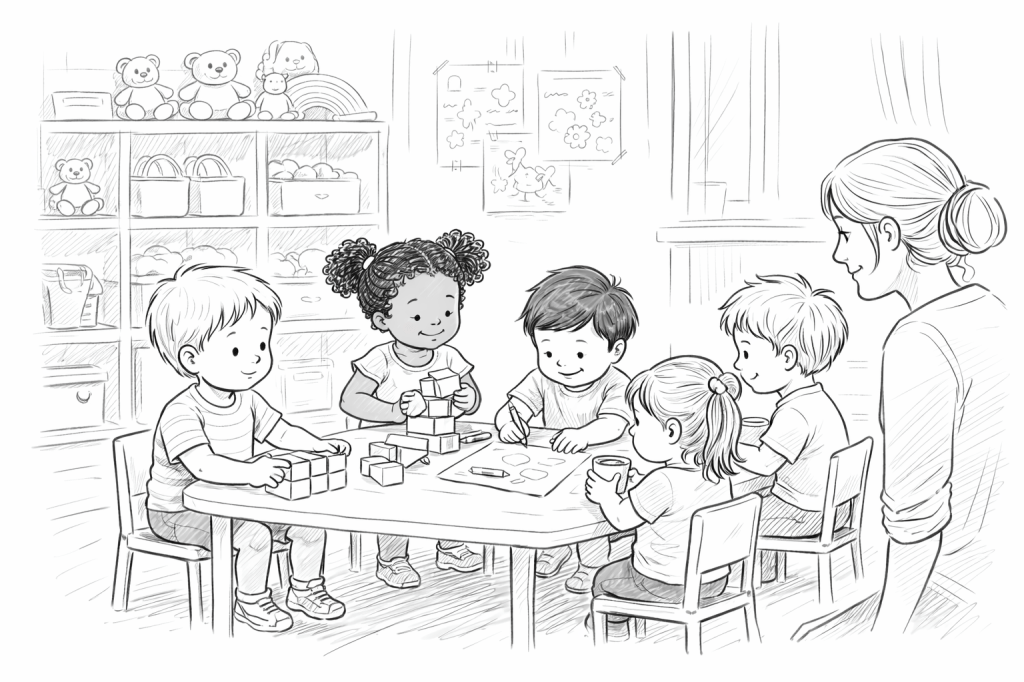
That said, she does understand me and my English-speaking family. I take comfort in that. It shows that under the surface, things are working. English has a place in her brain, and it’s growing quietly while she develops into her full bilingual potential.
What I experience is supported by research: Children’s language use is often better predicted by language dominance in their wider environment than by parental strategy alone.
Things like temperament, developmental profile, peer groups, and broader social context all play a role. And those aren’t things you can easily engineer.
In short: bilingual development happens in an ecosystem, not a vacuum.
So what can you influence?
For example, when my daughter asks for a snack in German, I’ll often recast the moment gently: “Oh, you want a snack? Sure, you can have a snack. Thanks for asking so nicely.”
I used to just parrot her question back in English, hoping to model it, until I realised she thought I was asking her. (“Can I have a snack?” “Yes, Mummy, wir essen Snacks together!”) Oops.
Even now, with all the recasting and input I try to give, she’ll often stick to German sentence structure and phrasing. And honestly? I get it. It’s the language that surrounds her, and I’m just one voice in a tidal wave of German.
Still, that one voice matters. The research says so. And my gut agrees.
Here’s what you can influence:
- Offer consistent, emotionally rich input
- Build routines where your language is normal and expected
- Support comprehension without turning language into a battleground
- Maintain your child’s first language so additional ones have space to grow
- Create opportunities for interaction with other speakers
All of this matters. And yes, research backs that up.
But what you can’t do is pull a single lever and guarantee a bilingual outcome.
Here’s what I try to remember
Your role is to share, connect, encourage, and make space for languages to grow.
You plant the seeds. You nourish them. And then you wait, patiently, while they grow in their own shape, at their own pace. That’s what inspired my Maaster Plan logo!

Language development in bilingual children is shaped by environment, relationships, opportunities, and your child’s own agency. Not by one tired reply or a week that didn’t go to plan.
You’re doing more than you think!
Want more reflections like this? I send out a story-style newsletter once a month, sometimes twice. It’s part research, part real life, always bilingual-minded. You can sign up here.
 The Maaster Plan
Leave a reply to KW09/2026: Alle TCS-Blogartikel – The Content Society Cancel reply